Implementing AI
Frame your approach

Our Recommendation
None of the below was generated by AI. It was authored by our CEO and Chief Architect – Matt Rollings.
Most organizations are not ready for AI. Implementing AI agents, and predictive planning requires a level of maturity that most organizations to not possess.
Our recommendation is to not rush.
It is a 3-5 year journey to create the foundation for robust use of AI agents the way most executives envision.
Your AI implementation partner needs to have expertise in the following areas:
- Process Design
- Data Modeling
- Budgeting and Forecasting Transformation
- Technical financial systems implementations
- Statistical Modeling
- Data Architecture and cleansing
- AI Agent deployment strategy
AI solutions will require a change in technology, culture, and process.
Be patient. Create a vision. Establish a foundation. Faithfully execute the roadmap with a premiere partner. Choose aptitude over politics. Success will be rare.

Implementing AI
AI strategy will consume most organizations.
AI will not become commoditized until after 2030; large scale success will be overshadowed by many failures.
Most organizations will try to take advantage of low hanging fruit by implementing AI to automate tasks, reduce headcount, and streamline spending. However, the reality is: AI is a strategic tool that must be accompanied by human oversight. Designing an AI-infused process will be iterative, intricate, and rife with many false starts.
Organizations will realize that a multitude of different AI models and agents will be required for different tasks. Each model will need explicit “guidelines” called system-prompts to ensure proper operation, and reduce risk.
Our AI implementation offering
What we do
We are not a firm that focuses on AI development.
We help deploy AI within your financial system infrastructure by:
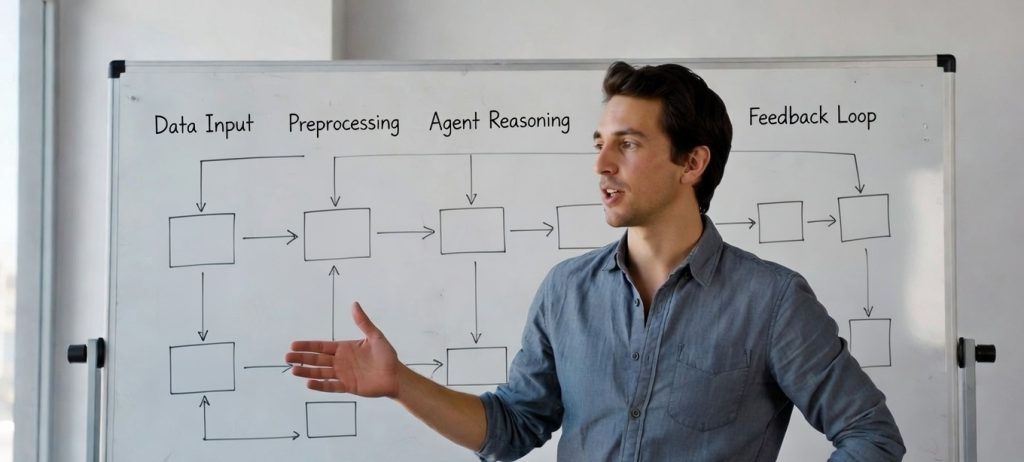
- Create and redesign processes and integrations that refine data flows to ensure to/from the AI agents (and predictive engines).
- Curating data feeds to ensure AI models receive the right data
- Create feedback loops which enable AI-driven iterations without overly complex solutions
- Create an AI Agent deployment strategy
- Partner to establish governance theory and processes
Creating a functional and technical process that supports AI agent effectiveness is what AI implementations are.
AI will not be able to replace a human and understand every datapoint and the intent behind each question in the near future. Establishing a stable and modular framework to provide data at the right depth to prevent the AI framework/agents from being overwhelmed by ‘noise’ is the challenge you will face.
Most partners cannot articulate the issues that surround AI implementations or provide guidance on how to make this happen as they lack one of the 6 core competences that are required for creating an AI process.

Keys to success
Each EPM tool has its own use cases to implement and leverage AI.
An assessment and strategy needs to be outlines for each product:
- Masterdata Management
- Account Reconciliations
- Consolidations
- Planning
- Tax
As organizations develop their strategy it should be understood that most automation can be created without AI – and the extent of the automation creates inherent complexity.
Use cases for each product should be either tactical, strategic, or advisory in nature where each agent has a specific role to perform – enforced by system prompts. Limiting an agent’s scope reduces token usage, improves output quality, and reduces the possibility of hallucinations.
System prompting for each agent should consider how logging is performed to assist with troubleshooting and reduce ‘black box’ hallucination failures.
Design related to use cases and agent deployment strategy is the single most important element to AI implementations and AI usage.
The quality of your design will directly dictate your success. Suboptimal solutions will outright fail.
Once successfully implemented from a technology perspective significant roadblocks related to governance and optimization remain. The initial rollout should trigger your organization to create a COE (Center of Excellence) for AI and continuous improvement across all business functions where AI is deployed.
If you need help – reach out – we’re here to make sure you can transition to the mid 21st century and not be left behind by your competition.